
Picture this scenario: You sell ₹1,000,000 worth of Reliance shares on a Tuesday afternoon. You are planning to withdraw the cash on Wednesday to make a down payment on a car. You log into your trading app on Wednesday morning, but the withdrawable balance shows zero. Panic sets in. Did the broker steal your money? Did the trade fail?
You check the market—the Nifty 50 is trading, and prices are moving. But what you failed to realize is that while it is a normal trading day, it is also a designated Clearing Holiday. Because the banks are closed, your money is effectively frozen in digital transit.
Understanding the intersection of the T+1 settlement cycle and regional bank holidays is one of the most critical risk management skills for an Indian stock market investor. In this comprehensive guide, we will break down exactly how your funds move, why they get delayed, and how to read the clearing calendar so you are never caught with a margin shortfall again.
What is the effect of a clearing holiday on stock market settlement?
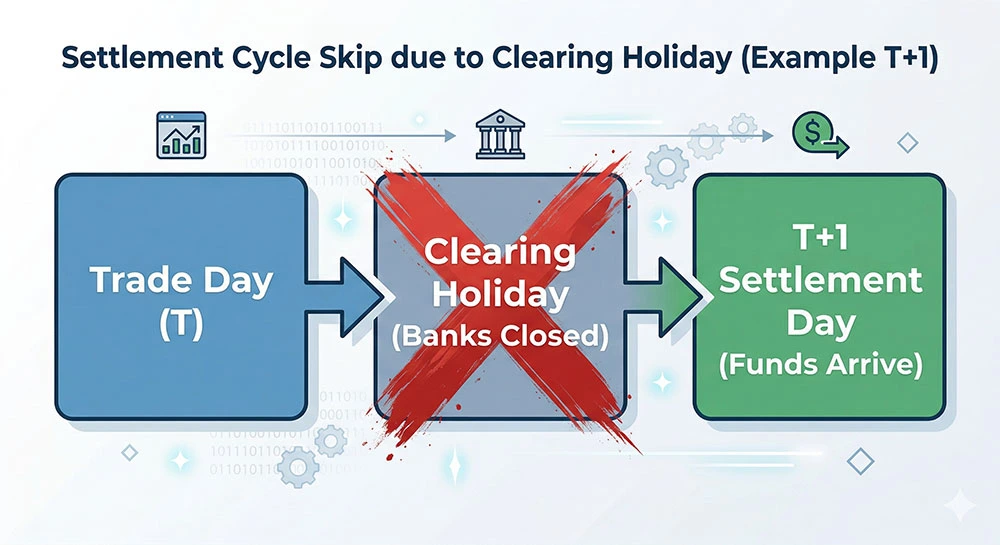
If a designated clearing holiday occurs during your standard T+1 settlement cycle, the physical transfer of funds and securities is paused for that day. While you can still trade normally on the exchange, the payout of funds from shares sold the previous day will be delayed by one additional business day until the banking infrastructure reopens.
The Baseline: How T+1 Settlement Normally Works
Before we can understand the delay, we must understand the rule. As of 2023, the Indian stock market operates on a globally leading T+1 (Trade plus one day) settlement cycle for the equity cash segment. This means the actual transfer of ownership (shares moving to your Demat account, and cash moving to your bank) happens on the next working business day after your trade.
- Trade Day (T): You execute a sell order for 100 shares of Tata Motors on Monday. The trade is recorded on the exchange, but the physical exchange of money and shares has not happened yet.
- Settlement Day (T+1): On Tuesday, the clearing corporations (like NCL or ICCL) work with the banking system to debit the shares from your Demat account and credit the funds to your trading ledger. By Tuesday evening, you can withdraw the cash to your actual bank account.
This is a highly efficient system—until a banking holiday interrupts the mathematical timeline.
The Interruption: The Clearing Holiday Delay
A clearing holiday (also known as a settlement holiday) is a day when the Reserve Bank of India (RBI) and major clearing banks are closed, typically due to a regional festival in Maharashtra (where the exchanges are headquartered) or an annual bank closing event. Crucially, the stock market itself remains fully open for trading on these days.
Because the banking infrastructure is offline, the clearing corporations cannot transfer money between the buyer's broker and the seller's broker. Therefore, the T+1 cycle simply hits "pause."
Example Scenarios of Settlement Delays
Let's look at how this impacts your actual trading timeline, assuming Wednesday is a declared clearing holiday (but a normal trading day):
- Selling on Monday: You sell shares on Monday. Normally, funds settle on Tuesday (T+1). Because Tuesday is a normal banking day, your funds arrive on time. The Wednesday holiday does not affect this trade.
- Selling on Tuesday: You sell shares on Tuesday. Normally, funds would settle on Wednesday (T+1). However, because Wednesday is a clearing holiday, the cycle skips Wednesday. Your funds will not settle until Thursday.
- Selling on Wednesday (The Holiday itself): You actively trade and sell shares on the clearing holiday. Because Wednesday is Trade Day (T), your funds will settle on the next normal working day, which is Thursday (T+1).
💡 SEBI's 80/20 Margin Rule During Holidays
Even though your full cash withdrawal is delayed by a clearing holiday, SEBI regulations still allow you to use 80% of the sale proceeds immediately on the Trade Day to buy other stocks. However, the remaining 20% will be blocked by your broker until the trade officially settles after the clearing holiday. Do not assume you have 100% buying power until the settlement cycle is complete.
How Clearing Holidays Impact Intraday and F&O Traders
If you are an intraday trader or you trade Futures and Options (F&O), the rules apply slightly differently, primarily affecting your Mark-to-Market (M2M) profits.
If you make a profit day-trading on a Tuesday, and Wednesday is a clearing holiday, that profit is unrealized in the eyes of the clearing corporation. Your broker will not add that intraday profit to your available trading margin on Wednesday morning. You will not be able to use those profits to take new positions until Thursday.
This is a massive trap for aggressive derivative traders who compound their daily profits into larger position sizes. If you over-leverage your account on a clearing holiday assuming your previous day's profits are available, your broker's risk management system will block the trade due to insufficient margin.
Impact on Mutual Fund SIPs and Lump Sums
Mutual fund transactions are entirely dependent on the banking system, meaning they are heavily impacted by settlement holidays. If you have an automated Systematic Investment Plan (SIP) scheduled to deduct from your bank account on the 1st of the month, but April 1st is the Annual Bank Closing (a clearing holiday), the deduction will fail to process on that day.
The Asset Management Company (AMC) will simply push the mandate to the next working business day. Consequently, you will receive the Net Asset Value (NAV) of the mutual fund at the end of the *next* working day, not the holiday.
The Defensive Strategy
Never base your personal financial commitments on T+1 settlement without checking the clearing calendar first. If you have an EMI bouncing, a credit card bill due, or a major purchase planned, you must cross-reference your sale date with our Official NSE & BSE Clearing Holidays Calendar. Always leave a one-day buffer to protect yourself from systemic delays.
Frequently Asked Questions (FAQ)
Why is my stock delivery margin showing in negative?
If you bought shares on a clearing holiday using the 80% credit from shares you sold the previous day, your broker may temporarily show a negative margin balance. This is an accounting visual. Once the banks reopen and the T+1 settlement catches up on the next business day, the ledger will balance out and the negative sign will disappear.
Does a weekend count towards the T+1 settlement cycle?
No. The T+1 settlement cycle exclusively counts working business days. Saturdays and Sundays are never clearing days. If you sell a stock on Friday, your T+1 settlement day is Monday. If Monday happens to be a clearing holiday, your settlement is pushed to Tuesday.
Can I buy shares with unsettled funds on a clearing holiday?
Yes, under current SEBI regulations, you can use 80% of the unsettled proceeds from a delivery sale to purchase new equity shares, even on a clearing holiday. You simply cannot physically withdraw the cash to your external savings account until the settlement is finalized by the clearing house.