
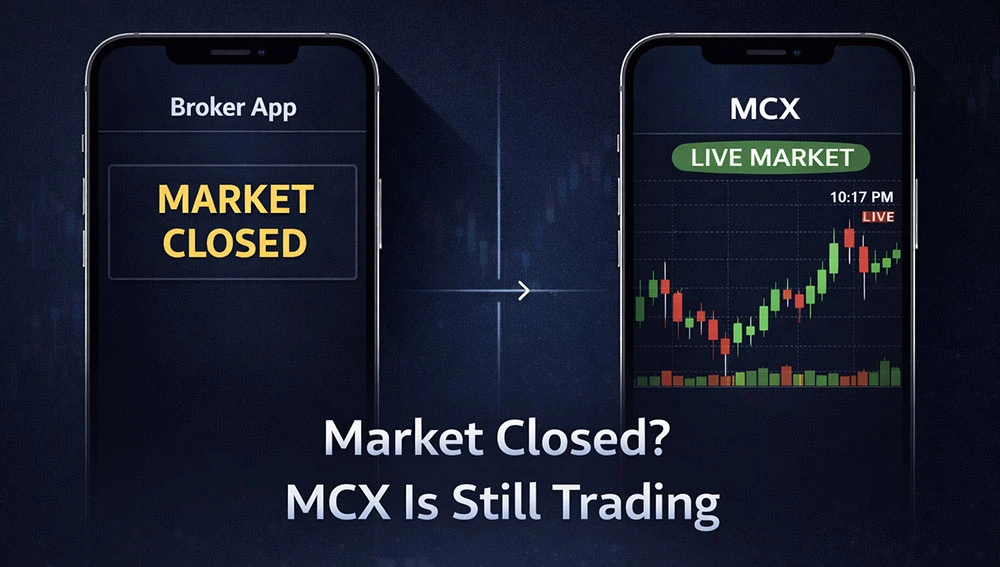
It is 4:45 PM on a public holiday in India. The National Stock Exchange (NSE) and Bombay Stock Exchange (BSE) have been completely shut down since morning. You open your standard trading application or mobile investing app, and right across the top of the dashboard, you see a prominent red banner declaring: "Market is Closed Today."
Assuming your trading day is over, you close the app. What you do not realize is that you just walked away from one of the most volatile and profitable trading windows of the week. At exactly 5:00 PM, the Multi Commodity Exchange (MCX) woke up, aligning with the US markets, and Crude Oil just made a massive 2% swing.
This scenario plays out thousands of times every single year across India. Retail traders are consistently misled by their own trading platforms during partial holidays. In this comprehensive guide, we are going to break down exactly why the technology behind your broker app lies to you, how the MCX split-session architecture actually works, and how you can stop missing out on crucial evening trading opportunities.
The Technical Reason: Why Broker UIs Get It Wrong
To understand why your app says the market is closed when commodities are actively trading, you have to look at how discount brokerages build their user interfaces (UIs) and manage their backend data feeds.
1. The "Blanket Flag" API Problem
Modern broker apps are built to serve millions of concurrent users. To keep the app fast and responsive, developers use overarching status flags in their code. When a major national holiday (like Mahavir Jayanti or Diwali) triggers a closure for the NSE and BSE, the broker's backend system flips a global `market_status = closed` flag.
This global flag pushes the red "Market Closed" banner to the homepage of every single user. The system is simply not nuanced enough to display a split message like "Equities Closed, but Commodities Open at 5 PM" on the main dashboard without causing UI clutter for the vast majority of users who only trade equities.
2. The Equities-First Bias
In the Indian financial ecosystem, equity traders vastly outnumber commodity traders. Brokerages design their homepage experiences specifically for the equity day trader and the mutual fund investor. Because the NSE dictates the primary sentiment of the Indian market, if the Nifty 50 is not trading, the platform treats the day as a definitive holiday, prioritizing the equity schedule over the commodity schedule.
💡 Developer Insight
If you navigate deep into the specific commodity watchlist on your trading app after 5:00 PM, you will often notice that the bid/ask prices are actually fluctuating, even while the homepage still screams "Market Closed." The data feed is live, but the frontend UI banner has not been removed.
Understanding the MCX "Split Session" Architecture
The root of the confusion lies in the unique way the Multi Commodity Exchange (MCX) operates. Unlike the NSE, which is highly localized to the Indian domestic economy, the MCX is deeply tied to global macroeconomics. Gold, Silver, Natural Gas, and Crude Oil are traded internationally 24 hours a day. If the Indian commodity market shut down entirely every time there was a regional Indian holiday, domestic traders would face massive gap-up or gap-down risks when the market finally reopened.
To solve this, the MCX created the Partial Holiday (Split Session). On many designated holidays, the exchange divides the day into two distinct phases:
- The Morning Session (9:00 AM to 5:00 PM IST): During a partial holiday, this session is strictly closed. The domestic physical markets are offline, and liquidity is generally lower.
- The Evening Session (5:00 PM to 11:30 PM/11:55 PM IST): This is when the magic happens. As the US markets wake up (specifically the COMEX and NYMEX), the MCX activates its trading engines. Volume spikes, volatility increases, and standard trading resumes entirely.
Agri vs. Non-Agri Commodities: The Hidden Catch
Even if you know about the 5:00 PM evening session, there is another layer of complexity that trips up traders. The MCX does not open *all* of its products during the evening session.
Non-Agri Commodities (Bullion, Base Metals, and Energy) are heavily influenced by global events. These are the assets that spring to life at 5:00 PM. If you trade Crude Oil, Gold, Silver, Zinc, or Copper, the evening session is your primary playground.
Agri Commodities (like Cotton, Mentha Oil, and Cardamom), however, are heavily dependent on domestic Indian spot markets (Mandis). Because the domestic spot markets are closed on public holidays, the MCX keeps Agri-commodities closed for both the morning AND evening sessions. If you try to trade Cotton at 6:00 PM on a partial holiday, your platform will rightfully reject the order.
How Different Trading Platforms Handle Partial Holidays
Let’s look at how various types of trading software manage the UX (User Experience) surrounding MCX partial holidays, and where you need to be careful.
Mobile-First Investing Apps
Applications designed primarily for beginners and mutual fund investors emphasize a clean, minimalist interface. Because their core demographic is highly equity-focused, their UI is very aggressive about declaring the market closed on holidays. Commodity traders using these mobile-first apps must be highly proactive in tracking independent market timings, as the application provides almost zero visual indication that the MCX evening session is about to commence.
Advanced Web Terminals
Professional-grade web interfaces tend to handle the transition slightly better, often quietly activating the commodity tabs once the 5:00 PM session begins. However, they can still suffer from aggressive browser caching issues, where the morning "closed" status remains stuck on the screen until you perform a hard-refresh of the web page.
Traditional Full-Service Broker Software
Legacy desktop software provided by traditional full-service brokers rarely features dynamic "Market Closed" banners. Instead, if you try to place a trade during the morning session, it will simply fail with an error code. While this is less visually misleading, it still requires the trader to manually remember that 5:00 PM is the exact time they are allowed to begin routing orders to the exchange again.
The Financial Cost of Missing the Evening Session
Why does any of this matter? Why not just take the day off when your app says the market is closed?
Because the evening session on a partial holiday is often the most critical window for commodity traders. Missing it can result in severe financial consequences or massive missed opportunities.
- US Economic Data Releases: The most market-moving data in the world—US Non-Farm Payrolls, CPI Inflation data, and Federal Reserve announcements—are almost always released between 6:00 PM and 8:00 PM IST. If you hold a Gold or Silver position and assume the market is closed, a hawkish Fed announcement could obliterate your margin while you aren't watching.
- US Crude Oil Inventories: Released weekly (typically Wednesday evenings IST), this report creates massive, violent swings in Crude Oil prices. If an Indian holiday falls on a Wednesday, the MCX evening session will capture this volatility perfectly.
- Gap Risk Mitigation: If you carry a commodity position over a partial holiday and fail to trade the evening session, you are forced to wait until the next morning to exit. By that time, the US market has traded for an additional 12 hours, and the MCX opening price the next day will gap massively, completely bypassing your stop-loss orders.
The Ultimate Solution: Decouple Your Intelligence
Your trading platform's job is to execute orders, not to be your official calendar. To survive as a commodity trader, you must decouple your market intelligence from your execution platform. Bookmark ismarketopen.in and keep our live, real-time dashboard open on a separate monitor. Our system tracks the exact 5:00 PM IST rollover mathematically, completely independent of your software's delayed UI updates.
Frequently Asked Questions (FAQ)
Why is my broker order rejected on a holiday if MCX is open?
If your order is rejected after 5:00 PM on a partial holiday, you are likely trying to trade an Agri-commodity (which remains closed), or you are trying to use a specific intraday product type (like Bracket Orders or Cover Orders) that the broker has disabled for the holiday session to manage risk. Stick to standard MIS or NRML orders.
Can I withdraw funds from my account during the evening MCX session?
No. Even though the Multi Commodity Exchange is open for trading, partial holidays are almost always concurrent with banking clearing holidays. The standard banking infrastructure (NEFT/RTGS) used by platforms to process payouts is closed. Your withdrawal request will not be processed until the next working business day.
Does the 5:00 PM open time ever change?
The 5:00 PM IST opening time for partial holidays remains constant throughout the year. However, the closing time changes based on US Daylight Saving Time. It closes at 11:30 PM IST in the winter months and extends to 11:55 PM IST during the US summer months.